
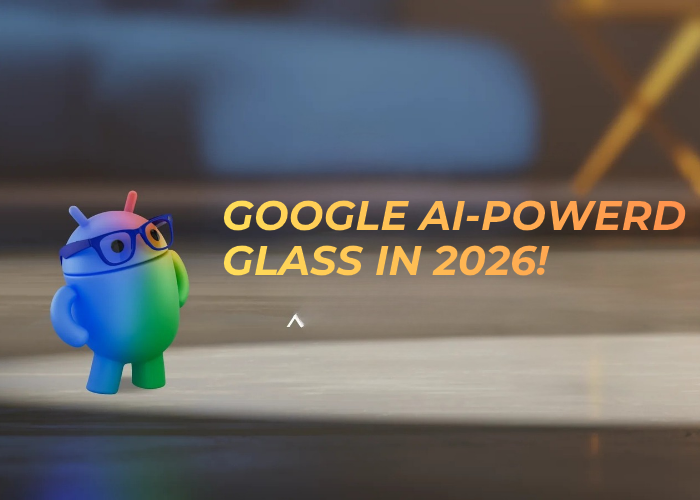
After years of experimentation in augmented reality (AR), Google is once again preparing to redefine how humans interact with digital information. The company’s renewed push into AI-powered smart glasses and extended reality (XR) partnerships signals a long-term strategy to fuse artificial intelligence, spatial computing, and mobile interactivity into a seamless ecosystem. This next-generation vision represents more than a single gadget—it’s Google reimagining the future of how we see and process the world around us.
At the heart of Google’s announcement is Project Aura, a family of AI glasses and display-capable eyewear built to run on Android XR. Google confirmed that the first consumer AI glasses will arrive in 2026, marking an important date for the industry and for developers planning XR experiences. Those devices are intended to be tightly integrated with Google’s Gemini AI, enabling hands-free interactions such as real time translation, contextual overlays, and visual search without forcing users to pull out a phone.
Ecosystem Partnerships: Samsung, Qualcomm, and Eyewear Brands:
To ensure the success of its AI glasses, Google has been quietly building a broader extended reality (XR) ecosystem—a unified framework that combines AR, VR, and mixed reality (MR) technologies. The company’s collaborations with major players such as Qualcomm, Samsung, and Unreal Engine aim to create a robust foundation for immersive devices and experiences.
Google confirmed it is co-developing an Android XR platform, optimized for wearables and headsets.Qualcomm’s Snapdragon xr2 Gen 2 platform, designed for high-performance mixed reality devices, is expected to serve as the hardware partner for this ecosystem. Meanwhile, Samsung’s involvement brings hardware manufacturing expertise and global reach, potentially paving the way for co-branded devices that merge Google’s AI with Samsung’s display and optics technologies.
How AI Enhances the XR Experience
Artificial intelligence is at the center of Google’s XR vision. Through Gemini and other AI modules, Google plans to add layers of contextual awareness to every digital interaction. The AI won’t merely overlay static information; it will understand what the user is seeing and why it matters in that moment.
- Live translation and transcription for real-time global communication.
- Personalized guidance in navigation, accessibility, or education through object and scene recognition.
- Seamless integration with Workspace tools, where users can view documents or participate in virtual meetings directly through a headset or glasses.
- Generative assistance, enabling users to ask for summaries, creative ideas, or visual explanations of what they’re observing.
Competing in the New Spatial Computing Race
Apple’s Vision Pro has reignited interest in spatial computing, while Meta continues to iterate its Quest series and Ray-Ban smart glasses with embedded AI assistants.
However, Google holds a unique advantage: its AI-first ecosystem covering Search, Maps, Assistant, YouTube, and Android. By connecting these services with wearable interfaces, Google can deliver experiences that feel familiar yet more immersive. For instance, Google Maps Live View could be integrated directly into the glasses, labeling streets and stores as you walk, or Google Lens could instantly identify landmarks and translate signs in your field of vision.
Google’s open development model may allow smaller startups and app creators to build AR experiences, unlike Apple’s more closed environment. This could help XR adoption spread faster, especially through affordable devices tied to Android smartphones
challenges for Google glass
Despite the excitement, Google faces notable hurdles. Battery life, heat management, and privacy concerns remain tough engineering challenges for always-on wearable devices. There’s also the social question: will users feel comfortable wearing AI-powered glasses in daily life, knowing they may include cameras or scanners?
To address these issues, Google has been emphasizing responsible AI design, ensuring transparency and consent in visual data capture. The company is also reportedly working on low-power edge AI chips that minimize data sharing with cloud servers, reducing latency and improving privacy.
PLAN MAP OF GOOGLE
Google’s renewed focus on AI glasses and XR partnerships reflects a long-term evolution rather than a short-term gadget launch. The convergence of Gemini AI, Android XR, and cutting-edge hardware suggests the company imagine a post-smartphone era—one where “looking” can be as powerful as typing or touching.
conclusion
As 2026 approaches, we can expect prototypes to evolve into developer kits and early consumer models. If Google succeeds in balancing usability, affordability, and privacy, its AI glasses could herald the next frontier of personal computing—an era where the digital world lives not in our pockets, but in our line of sight.