
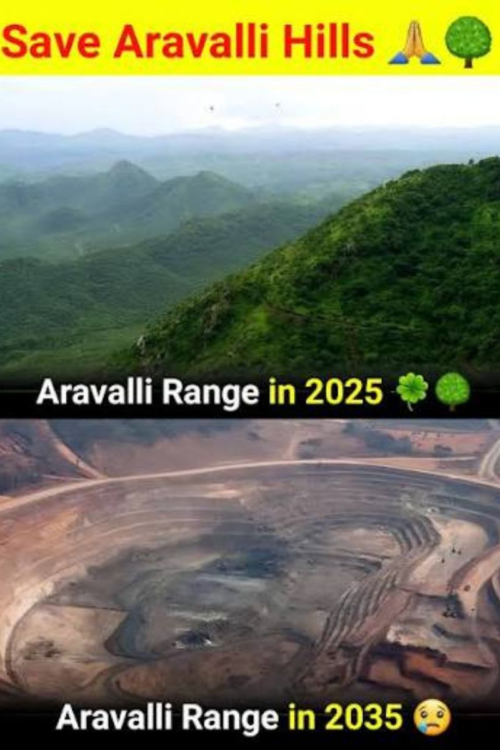
The Aravalli Mountain Range is one of the oldest mountain ranges in the world. It runs across western India for about 670 km, starting near Delhi and passing through Haryana, Rajasthan, and ending in Gujarat.
The range plays an vital role in India’s climate and ecology. It acts as a natural barrier, limiting the spread of the Thar Desert toward eastern India, supports forests and wildlife, and influences rainfall patterns in the region.
What is importance?
Aravalli acts as a natural barrier against desert expansion. The Aravalli help slow the spread of the Thar Desert towards fertile regions of Rajasthan, Haryana, and Delhi by supporting plant and holding soil in place.
The range plays a role in climate and rainfall. It influences monsoon winds, helping parts of Rajasthan and nearby states receive some rainfall. Without the Aravallis, much larger areas would be dry.
it is a major source of rivers and groundwater recharge. Many rivers like the Banas, Luni, and Sabarmati originate from the Aravalli region. The forests and rocky terrain help store rainwater and recharge aquifers.
the Aravallis support rich biodiversity. They provide habitat for wildlife, forests, and medicinal plants, helping maintain ecological balance in region.the range has economic and historical value. It contains minerals such as copper, zinc, and marble, and has supported human settlements, trade routes, and ancient civilizations for thousands of years.
Who want to demolish Aravalli?
The Aravallis are being harmed mainly due to illegal mining, real estate and construction projects, industrial expansion, and infrastructure development.These activities are carried out by:
- Private mining operators and builders, sometimes operating illegally.
- Real estate developers, especially near Delhi NCR and parts of Rajasthan.
- Industries that extract minerals like stone and marble.
- Local interests that clear forest land for short term economic gain.
Over the years, courts and governments have tried to stop this. The Supreme Court of India has banned mining in many parts of the Aravallis, and environmental laws exist to protect the range. The problem is weak enforcement and violations on the ground.
So, it’s not about someone wanting to destroy the Aravallis openly. It’s about economic pressure, illegal activities, and poor regulation slowly damaging one of India’s most important natural barriers.
Who protest against Aravalli mining?
Many people and groups have protested against the dimolation of the Aravalli mountain range over the years. These protests come from civil society, not the government or businesses.
- Environmental activists and NGOs,(Organizations like environmental foundations, local green groups, and national NGOs have led campaigns to stop illegal mining and deforestation in the Aravallis. They raise awareness, file legal cases, and pressure authorities to act.)
- Local villagers and tribal communities,(People living in and around the Aravalli region have protested because mining and construction damage their land, water sources, forests, and livelihoods.)
- Students and youth groups,(University students and youth-led climate groups have organized marches, petitions, and social media campaigns, especially in Delhi NCR, Gurgaon, and Rajasthan)
- Environmental lawyers and public interest litigants,(Several activists and lawyers have approached the courts through Public Interest Litigations. Their efforts led to Supreme Court orders banning mining in many Aravalli areas)
- Concerned citizens and urban residents,(Residents of Delhi, Gurugram, Faridabad, and nearby cities have protested because the Aravallis help reduce pollution, recharge groundwater, and control climate extremes.)
What is recent status of Aravalli mining?
Supreme Court and government framework,In November 2025, the Supreme Court of India accepted a new, uniform definition of what counts as the Aravalli Hills and Aravalli Range for regulatory purposes. This definition includes criteria like landforms with at least 100 metres of elevation and a specific proximity rule for hill clusters. Critics say parts of the ecosystem not meeting the new definition could lose legal protection.
Mining restrictions and protection claim,The central government and Environment Minister have been clear that no relaxation of mining protections is intended. They say over 90 percent of the Aravalli region remains protected and that any mining activity will be allowed only in a very small, scientifically identified portion.
Nearly no new mining leases,Minister Bhupender Yadav has said that new mining leases will not be granted until a comprehensive sustainable mining plan is developed by the Indian Council of Forestry Research and Education. Existing mining can continue only under strict environmental safeguards.
Illegal mining remains an enforcement issue,Despite bans and legal definitions, illegal mining in parts of the Aravalli region continues to be a problem that authorities are trying to manage with monitoring and enforcement efforts.
- DISCLAIMER: In this article we try to give you as much as possible knowledge regarding Aravalli mountain Range you not satisfied or find any false information regarding this content, please feel free to contact us.